What holds matter together?
Choose an atom, build a picture of a molecule, then look beyond the shell model.
START WITH THE OUTSIDE ELECTRONS
Which atom are we looking at?
Counting diagram. Rings are energy levels, not physical tracks.
Why don’t valence electrons and valency mean the same thing?
Valence electrons are the electrons in the outermost occupied shell. Valency describes how an atom combines. In these simple examples, oxygen has 6 valence electrons and usually forms 2 bonds. Carbon has 4 and usually forms 4. Hydrogen has 1 and usually forms 1. Some elements have more than one valency.
SHARED PAIRS HOLD ATOMS TOGETHER
One single bond, two electrons
Atoms can overlap when viewed end-on. Rotate to see the bonds. Sizes and bond lengths are illustrative.
Is a molecule always a compound?
A molecule is a separate group of covalently bonded atoms. Oxygen gas, O₂, contains just one element, so it is a molecular element. Water, H₂O, contains two elements, so it is a molecular compound. Solid sodium chloride forms a lattice of ions. Its formula describes the simplest ion ratio rather than a separate NaCl molecule.
A MORE ACCURATE PICTURE
A cloud of possibilities
3D probability samples viewed on a flat screen. Display scales differ.
ORBITAL ≠ ORBIT
Where might we find it?
How does this connect to shells and bonding?
A shell groups orbitals by their principal energy level. The first shell has one s orbital, which can hold up to two electrons. The second has an s orbital and three p orbitals, which can hold eight electrons in total. Each p orbital has two lobes but is still one orbital.
Valence electrons occupy the outer shell. In a covalent bond, the electron distribution extends across the bonded atoms. A shared pair is attracted to both nuclei. The hydrogen clouds here show isolated atomic orbitals, not a calculated cloud for a whole molecule.
USE THE PARTICLE PICTURE
Connect the ideas
QUESTION 1 OF 5
Two ways to bond
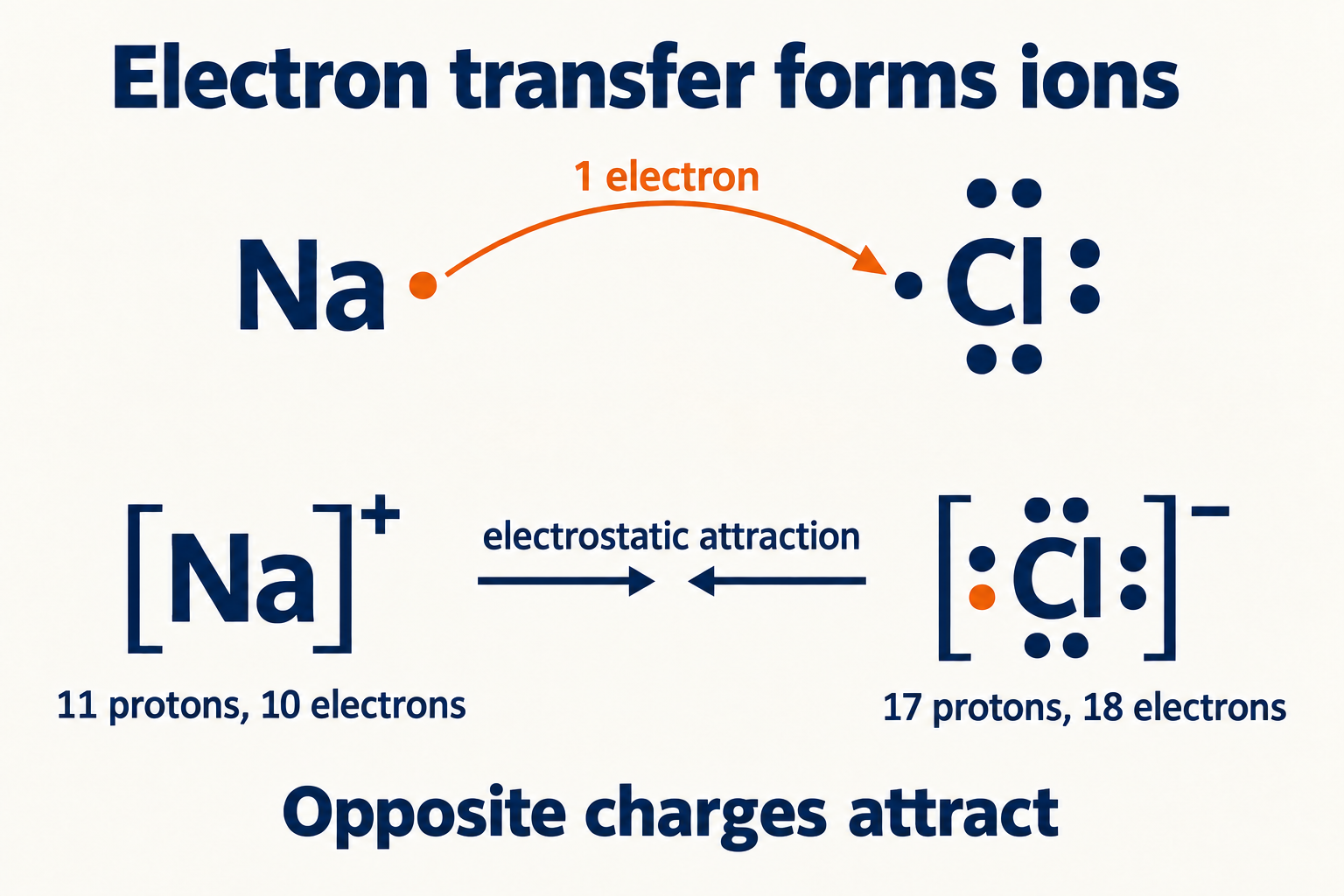
Ionic: transfer, then attraction
Electron transfer forms positive and negative ions. Electrostatic attraction holds them in a lattice. In solid salt, the ions stay in fixed positions. Molten or dissolved ions can move and carry current.
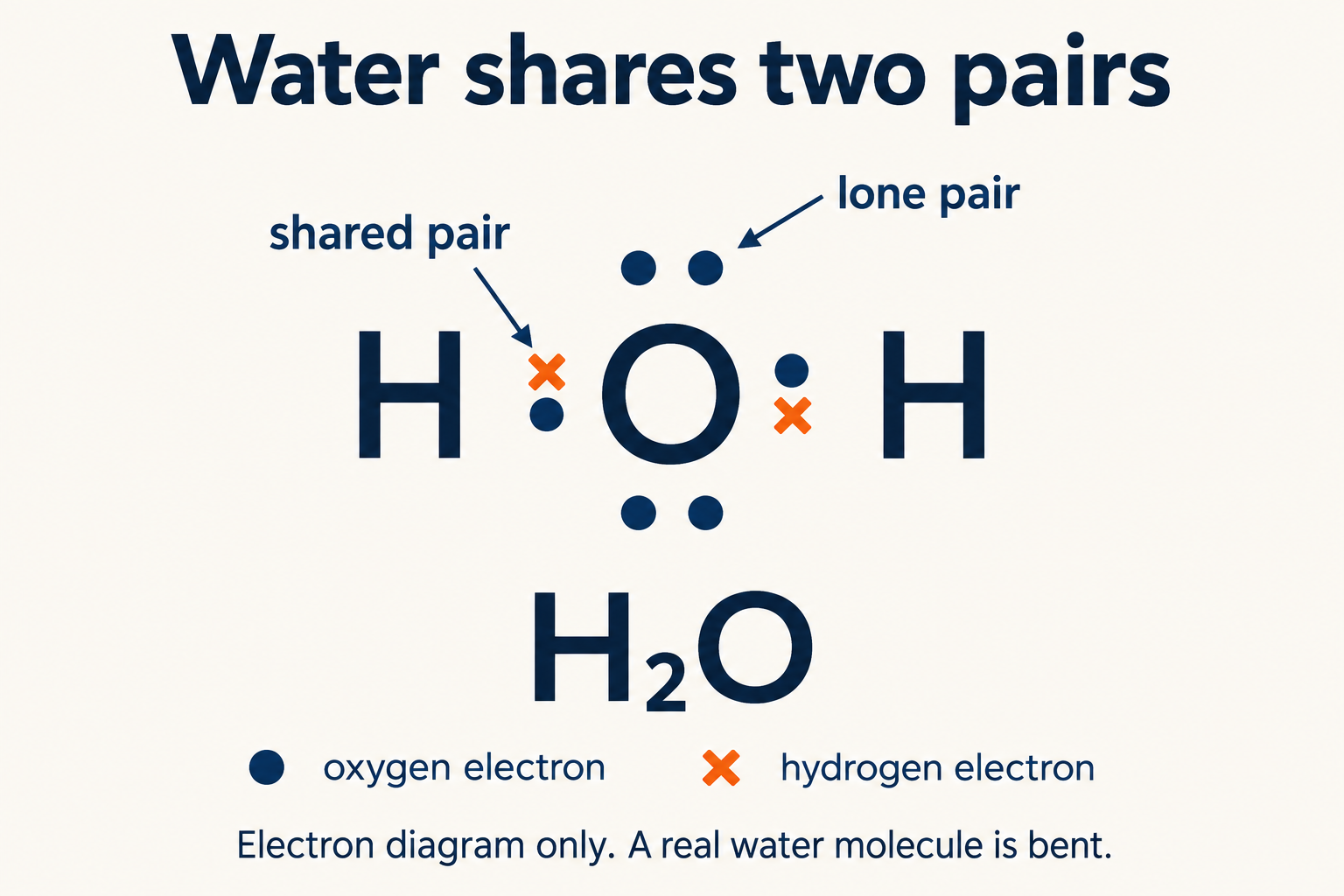
Covalent: share electron pairs
Each shared pair is attracted to both bonded nuclei. Water has two shared pairs and two lone pairs on its oxygen.
Names and charge balance
CaCl₂ is calcium chloride. One Ca²⁺ needs two Cl⁻ ions to balance its charge. FeCl₃ is iron(III) chloride. CO is carbon monoxide and NO₂ is nitrogen dioxide. Mono means one, di means two and tri means three.
Flame-test revision
Change the metal salt (independent variable). Observe flame colour (dependent variable). Keep sample amount and flame conditions consistent. Prevent contamination for validity. Repeat for reliability. Eye protection reduces splash risk and tied-back hair reduces ignition risk. Follow the teacher’s laboratory procedure.
Properties and uses
Insulating plastic has very few mobile charge carriers, which suits wire coatings. Suitable electrolytes contain mobile ions that carry charge. Simple molecular substances often melt easily, but covalent substances vary: diamond has a giant covalent structure and graphite conducts electricity.
KEEP LEARNING
Lesson & explanations
The full worksheet companion includes naming, formula writing, flame tests and properties.
Play Molecule Workshop → · Build seven molecules, one shared pair at a time.
Listen to the explanation
A read-aloud version of the current section.
Uses an available voice on your device.